Showing posts with label Tara G. Show all posts

Wednesday, March 9, 2011

Wednesday...wow it feels like a tuesday!

"Plantlets"
Spider Plant at my house :)


We started the class by turning in the plant lab which was due today. We then talked about the AMAZING plant of the day, which was the SPIDER PLANT! An interesting thing about the spider plant, is that it can self-propagate. This means that it can produce a baby plant of itself that roots in the soil. "Plantlets" are spider babies that the plant produces. It is a common houseplant that produces white flowers. After we finished talking about the plant of the day, Mrs. Stein demonstrated with the class Venus fly trap of how it closes to catch prey. She stuck a metal object inside an open trap and it closed up. It was pretty cooolll!!

Then we had a discussion about energy by answering a worksheet with our lab groups. Afterwards, talked about the questions as a class and Mrs. Stein elaborated on them.
Some of the questions were: (in up page 61)

Q:What is energy? Describe some characteristics of energy.
A: It is the ability to do work and it cannot be created or destroyed. It is TRANSFORMED!

Q: What is energy used for in living things?
A: to live and carry out functions

Q: What contains energy?
A: light, electric, sun, heat, chemicals

Note: When we consume food, we are consuming chemical energy which is stored in electrons of chemical bonds. In our body, our mitochondria is producing ATP.

Q: Why should you wear a white shirt on a hot day, not a dark shirt?
A: Dark colors absorb more heat or wave lengths of light and a white shirt reflects all wave lengths of light.

Q: What do you know about photosynthesis?
A: It is the process by which plants convert light energy into chemical energy. The energy is stored in bonds of carbohydrates and plants make glucose by using photosynthesis.

Q: Describe the structures of a leaf that allow it to carry out the function of photosynthesis.
A: The shape of the leaf, being flat, increases SURFACE AREA which allows maximum light absorption. The cuticle prevents water from evaporating and the palisade layer is compacted with many chloroplasts. It is towards the top which allows maximum light absorption.

We talked about now light travels in waves and how colors have different wave lengths. "White" light is a mixture of all colors in the visible spectrum and plant pigments absorb sunlight. Chlorophyll has green pigments which is needed for photosynthesis. It reflects mostly green and it absorbs most all other colors.

We also reviewed Mrs. Stein's blog because SAM did not blog...so look at her post from last night.

HOMEWORK:
1. Read section 8.2 and 8.2 with UP pages 81-85 OR a reading strategy of your choice that fits reading-DUE FRIDAY!
2. Work on plant national park project
3. up pages 67-68

THE NEXT SCRIBE IS.....MADISON!

Tuesday, January 11, 2011

TEST REVIEW!!!!!!!

Here are some review questions that will hopefully help with studying :)

Q: What is the importance of the reproductive system?
A: It is important to the survival of a species and it may increase genetic variation.

Q: Describe the difference between Asexual and sexual reproduction and give examples.
A: Asexual is when there is one parent and the offspring is a clone. Some examples are, bacteria, plants, and other simple organisms. Sexual reproduction is the joining of gametes which increases genetic variation. Some examples are, plants, and many animals.

Q: What are the different male reproductive parts? Describe them.
A: Testis is the site of the sperm production that produces chromosome testosterone. The scrotum contains the testis maintaining the temperature at below body temperature. The Epididymus is the site where the sperm mature and the Vas-derin carries the sperm from the testis to the urethra. The Urethra carries urine and sperm out of the body. The penis is an external reproductive organ.

Q: What does testosterone cause?
A: Muscle growth, pubic hair, broad shoulders, and facial hair

Q:What are the female reproductive parts? Describe them.
A: The ovaries contain the follcies where the eggs mature and where hormones are produced. The Fallopian tube is where the egg travels down and into the uterus . The urethra tube carries urine from the bladder to the opening to the entrance of the vagina. The oviduct carries eggs from the ovary to the uterus where fertilization occurs.

STUDY THE PICTURES IN YOUR PACKET FOR MORE INFO ON THE REPRODUCTION PARTS!

Q:What is internal fertilization and external fertilization?
A: External is where the gametes join outside the body where you need large number of gametes and water. Internal is where the gametes are joined inside the body where you need specialized organs and mating rituals.

Q: What is ectoderm,mesoderm, and endoderm?
A: Edoderm-living of digerstive, roproductive, and repiratory system
Mesoderm- muscles, blood, and the bones
Endoderm-skin and nervous system

Q: Describe the positive feedback loop.
A: The ovary releases low levels of estrogen which stimulates the hypothalamus to release hormones to the pituitary glad which gives off FFH to the ovary.

Q:What is the difference between Amnion and the Chorion?
A: The Amnion develops into the amniotic sac which cushions the fetus and the Chorion is a membrane in mammals to develop the placenta.

Q: What is Tubal Ligation?
A: getting the fallopian tubes tied to prevent pregnancy

Other things to know for the test:

Endocine system- Regulates bodily function and maintains homeostasis and it signals secrete hormones into the bloodstream

Hormones- chemicals released into the bloodstream (ex. Estrogen)

Pituitary glad- secretes nine hormones and regulates other endocrine glands

Other things to help prepare for the test 2maro......Review pages in packet (19 &20)

Homework:
STUDY FOR THE TEST WHICH IS 2MARO!!!!!

The next scribe will be..talkative TAYLOR! lol

Thursday, December 2, 2010

YAYYY 2maro is FRIDAY!!!!!!!!!!!!!!!!!!!

Dihybrid Crosses
Miosis One


How to foil


First, I want to say that I'm sooo sorry that i forgot 2 do the blog Wednesday night!! I completely forgot :(

WEDNESDAY: We started the class with a wonderful Mitosis Square dance video and we were allowed to get up and dance but...nobody did haha! Then Mrs. Stein gave us a stamp for the homework. We went over questions seven and eight because many people had questions. Mrs stein told us that we should not skip any steps on the pun it squares because you will be "toast" and she will "annihilate you!!" You must separate your gametes (alleles) in order to move on to the next step because it is a step in Mitosis. Mrs. Stein also posted a video on the blog if Tuesday's class was confusing, so she explained her video. She also mentioned that there is a link to a Mitosis video on Moodle if you need it. Bridget asked a WONDERFUL question on the Mitosis stages and the number of chromosomes in each stage. Then we took notes on Mitosis which was put on moodle if u need them. We also talked about the crossing over that occurs in Prophase II and its when the chromosomes exchange portions of their chromatids. In men, four sperm cell is made and in women, one egg is made. In addition, we learned Mendels Law of independent assortment which is when explains alleles separate form each other and it leads to the formation of many gametes. Mendal is the father of genetics and he was a monk that mated pea plants. We also did a Practice problem which was...."In aliens, three eyes is dominant to two eyes. A heterozygous three eyed alien mated with a two eyed alien and had eight alien babies. How man would you expect to have two eyes?" the answer was a probability of a 50% chance of 8 alien babies. Try figuring out how we got this on your own if you missed class and ask Mrs.Stein for help tomorrow if you don't understand it. After this practice problem, we did a lab that was on page 23 and most people finished this lab in class.

Homework:

Finish the Lab and read 11.1 and 11.2

THURSDAY:

We started the class by turning in the lab pages. Then we took notes on probability. Probability is the likely hood that a particular event will occur and it is used to predict outcomes. If you flip a coin four times in a row, the probability that it will land on tails all times is one sixteenth. We also took notes on dihybrid crosses which is a two trait cross that uses two sets of alleles from both parents. It has the same steps EXCEPT determining the parental gametes is more complex. You have to foil (First, Outside, Inside, Last) the gametes and then put them on a punnet square to find the parental gametes. An example of a punit square is on the blog that shows how to find the parental gametes. I would also recommend that you watch all the videos that Mrs. Stein posted because today's class would be confusing if you missed it and the information is going to keep building as the days go on.

Homework:
1.Read 11.3 and do Cornell notes
2.Do pages Up 33 to 35

Sorry again for not doing the blog!! I hope this helps people who were absent :)

ANDD the next scribe will be Serena!

Monday, November 8, 2010

Monday Class!!

Primary and Secondary Response


HIV Virus


In class:

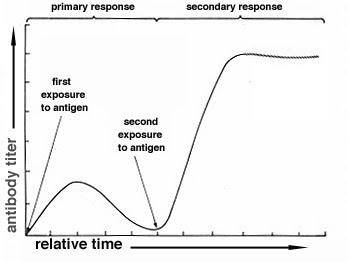
At the beginning of class, we turned in UP page 32, UP pages 37-42, and your postcard. Then we went over Primary and Secondary response which had to do with the picture that was on Yvette's post and also shown above. The main difference between the two is that Secondary response uses memory B-cells and it allows it to produce more quickly.

Then we completed the immune system tree map by taking notes on Acquired Immunity. There are two types of Acquired Immunity which are active, and passive. Active immunity is when your body makes the antibodies. An example of this would be a vaccine or a exposure to the disease. Passive immunity is when your antibodies are obtained passively. An example of this would be by breast milk or a injection of antibodies. Active immunity has longer lasting memory cells when passive immunity is more temporary.

Afterwards, we took notes Immune system disorders such as Allergies, Autoimmune Diseases, Immunodeficiency Disease, and the HIV virus.

Allergies are overreactions of the immune system that produces mast cells to produce histamines. The histamines are chemicals which increase the blood flow and your fluid production such as tears and mucus. They also signal inflammation.

Autoimmune Diseases is when your immune system mistakenly attacks its own cells. Some examples of this is type one diabetes,Rheumatoid Arthritis, and Multiple Sclerosis.

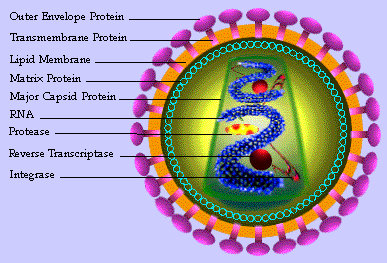
The Immunodeficiency Disease is caused by the HIV virus. One of the most commonly known Immunodeficiency Diseases is AIDS. The HIV virus and the AIDS virus is transmitted through blood or body fluids. HIV is detected with the presence of HIV antibodies and it causes the helper T-cells to be unable to activate the B-cells and T-cells which result in the inability to fight off the disease. The HIV virus is very sneaky and it uses RNA to produce DNA which is commonly known as a retrovirus. This virus is so problematic because it invades defenses of the immune system and destroys your helper T-cells. Your helper T-cells tell the other cells what to do and without them, your cells wouldn't know what to do. In class we watched a animation on the production of the HIV virus and Mrs. Stein put the video on moodle.

Mrs. Stein asked the class for questions they had on the test. For question 5 on the objective sheet, you don't need to know any of the diseases that we didn't talk about and be familiar with the pathogens for the diseases we did talk about. She will be having a review session tomorrow morning and everyone is welcome!

At the end of the class, we watched a movie on bird flu which was spread from bird to bird by their poop. This is not a major problem in humans today but may develop as a serious problem in the future.

Homework:

STUDY FOR THE TEST TOMORROW!!!! (Optional study session tomorrow morning with Mrs. Stein!)

READ SECTION 35.4

P.S. I HOPE YOU FEEL BETTER MRS.STEIN!! (She lost her voice and wasn't feeling so well :( )

The next scribe is Bridget!!

Saturday, October 9, 2010

Fun Sunday Adventure!

Turkey's Feet or Big Blues Stem


Yellow Indian Grass


October 9th Restoration Day at the Grove: I found out that in order to cut down buckthorn it had to have rained the prior day. Since today was such a beautiful day, the Grove had a day for people to help out in other ways. Today I went and helped pick seeds at the Grove to help restore their prairies and grasslands. We picked the seeds from each of the plants and put them in brown paper bags. Above i attached pictures of two different plants that we picked to get seeds from, which were the Yellow Indian Grass and the Turkey's Feet. These two plants are native plants to the Grove and many of the invasive species are taking over their land. These plants will die before the winter and then the Grove will replant the seeds and the snow will push them down into the soil. While picking the seeds, the leader told us a lot about the Grove's land and how much they appreciate our hard work.
In 1836, the Kennicotts came to the land and Mr.Kennicott was the first doctor and mail man in the area. He became a famous scientist and that's why they ended up keeping the land and naming it the Grove. Mr.Kennicott started the seed business and started planting all different plants to sell throughout the area. When they got to the area known as the Grove now, they had 800 ares but they now only have 123 ares. This is because we have built buildings, roads, houses, banks, and much more on the land that once belonged to them. The leader told me that not only are the invasive species taking over the land of these plants but so are we. Helping them by picking the seeds is a great way to keep these plants in the Grove. I learned today that a pound of the Yellow Indian Grass could be sold for about $100! Wow that's a lot!

I had a ton of fun helping out at the Grove and they want me to tell u guys that they need more helpers!!!

Sunday, September 19, 2010

Fun Friday Class!

 Dandelions

 Plantains


Clover


Set up of lab 58 above


Friday September 17th,2010


In class: We were given the grading rubric for the alien species project and we were able to ask any questions we had about the project. Mrs. Stein had the sheet out so students could sign up for the differnt species. Only two people per species are allowed, so sign up as soon as you can.


After everyone was done asking questions, we went outside to start on Lab 58. In this lab, we learned about the different density populations by counting the number of different plants in each square-meter. Density population is the number of species in a certain area. (plants/m2) The three weeds that we were looking for in our area were Dandelions, Plantains, and Clover. We placed popsicle sticks in the ground, one meter apart at the corners of the square. Then, we divided our area into smaller areas to count the number of different weeds in each section. Many people were confused on what each plant looked like so i included a picture of each above. In the lab, we made a drawing of what our area looked like and then we made a table of the number of plants in each of the sections. After fnishing the lab, we went inside and put the group's data together to make a class data table. To find the population density, we added the numbers and then divided by the area of the quadrants.


Mrs.Stein added a link on the blog about the different times and more imformation on the Grove extra credit.

The next scribe is Melissa

MEET IN IMC MONDAY TO WORK ON YOUR OIL SPILL PROJECT OR YOUR ALIEN POSTER!!

Homework:
Oil Spill Project due-9/21
Finish Lab 58-due Monday

Cornell notes section 6.3-due Monday
Alien Poster-due 9/27
Extra Credit-due 9/25